
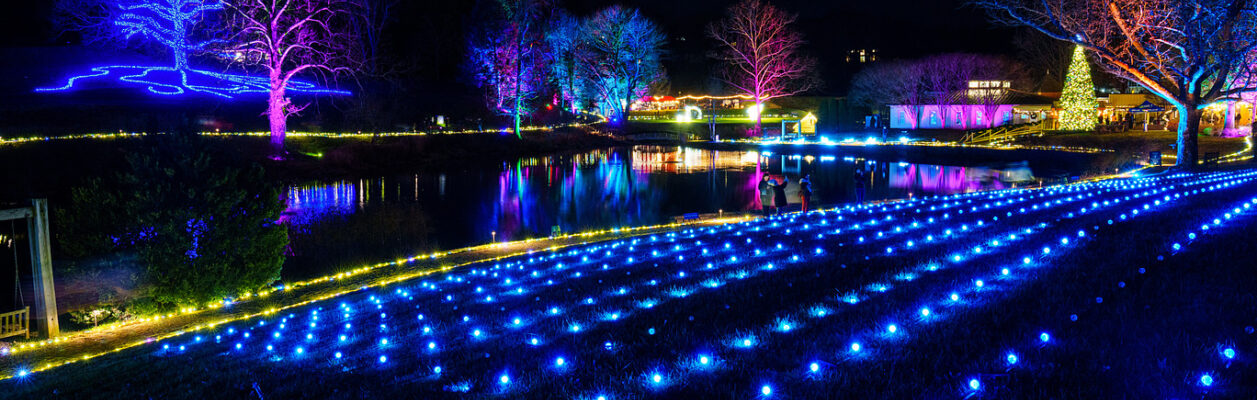
AKA How We Keep 4–15,000 Universes of Data From Melting Into Holiday Chaos
Let’s clear something up: when people walk through a large scale Christmas light installation and say, “This is magical,” they’re right — it is magical. But it’s also a logistical monster built out of power distribution plans, miles of data cables, DMX universes, pixel maps, and at least one technician in a lift muttering to themselves while trying to outsmart a wind gust. This is the part of Christmas people don’t see, and honestly, one of the reasons we love what we do.
We get questions like the one below about the behind the scenes, especially from students and clients who stare at a 70-foot tree blinking in perfect choreography and wonder how it’s not powered by Santa’s workshop:
“How do you actually power and control all these lights?”
So, let’s peek behind the curtain.
Set-and-Forget vs. Programmable: Two Flavors of Holiday Lights
In the wild world of Christmas lighting, most installations fall into two families. The first are the steady, reliable, “don’t look at me, I’m working” lights. We affectionately call them set-and-forget because you really do just plug them in and walk away. These make up roughly 60 percent of most holiday displays. They’re the workhorses — perfect for tree wraps, walkways, plazas, or anywhere the goal is to create atmosphere rather than spectacle. They don’t flicker, chase, dance, or sync to your favorite Mariah Carey track. They just glow beautifully, consistently, and without attitude.
Then there’s the other family of lights — the programmable ones. These are the divas. The show ponies. The lights that want attention and know how to get it. They sparkle on cue, shift colors on beat, ripple like water, pulse like a heartbeat, or chase in sync across an entire resort courtyard. They’re driven by data instead of dumb wiring, and they allow us to create the “WOW” moments guests photograph and post everywhere. When you see a feature installation doing its own mini Broadway audition? That’s programmable lighting. Those lights have opinions, and we love them for it.
The Brains Behind the Beauty: DMX, Pixel Mapping, and Data Universes
Now for the part that makes lighting designers nerd out and normal people blink twice.
We use DMX 512, the industry-standard control protocol, to tell our intelligent and RGB fixtures what to do. If that felt like a foreign language, think of DMX as the postal service of lighting control — it delivers instructions from a console or playback device to every light in your system. One DMX “universe” contains 512 channels. A single moving-head light may use dozens of those. A giant programmable tree might use thousands. Big installations? They can involve 4,000 to 15,000 universes of data. Yes, a thousand. Your holiday lights are basically running a small metropolitan data grid.
But DMX is only part of the story. When we’re doing intricate animation — snowflake twinkles, waterfall effects, color sweeps that glide up a tree like Northern Lights — we’re using pixel mapping. Pixel mapping is the choreographer of the lighting world. It tells every individual pixel what to do and when. Great pixel mapping feels like magic; bad pixel mapping feels like your tree sneezed.
How We Power It All Without Turning the Property Into a Darkened Tundra
People often assume there’s some sort of “Christmas ON” master switch. A single button that lights up the universe. We wish. Reality is a little more… electrical-engineering-y.
Thank goodness for LEDs. If we were still using incandescent lights on the scale of our current jobs, we’d be blowing fuses across entire zip codes. LEDs are bright, durable, and sip electricity instead of guzzling it. They make large-scale holiday displays possible without rewriting the municipal grid.
Behind every installation is a carefully orchestrated power distribution plan. We balance loads, route cabling safely, keep connectors accessible for troubleshooting, and think through both weather exposure and guest flow. Every resort or theme park has its own quirks. For example, places like the award-winning Boar’s Head Resort require thoughtful layout design to ensure guests never see what we lovingly call the “electrical spaghetti.” What looks simple and elegant on the outside is usually hiding an entire infrastructure underneath.
The Console Side of Christmas: What We Actually Use
People ask us all the time what consoles we run, expecting there to be one magical piece of hardware that solves everything. The truth is that control systems change project to project, depending on what the installation needs.
For intelligent lighting like moving heads, we’ll typically run GrandMA or ETC. They’re reliable, powerful, and handle complex cueing beautifully. For pixel programming, we often lean on xLights or ELM, depending on the design complexity. Audio isn’t a huge part of most of our outdoor displays, so we normally use a basic mixer and a WAV/MP3 playback device rather than full-blown sound consoles. Every setup is a custom cocktail — built for the job, not for the name-brand flex.
We use the tools that are appropriate based on our client’s BUDGET and CLIENT’s NEEDS. There is no one control system to rule them all!
The Human Side: What Running a Massive Holiday Display Actually Looks Like
If you want a mental snapshot of our team during install season, picture this: one tech is zip-tying data cables with the focus of a surgeon, another is programming pixel effects at 2 A.M. because “the tree needs more purple,” someone is forty feet up in a lift talking nicely to a stubborn RGB node, and someone else is knee-deep in a tote labeled “IF THIS IS DEAD PIXELS AGAIN... I SWEAR.”
We laugh about it now because honestly? We love this.
There’s nothing like the moment when everything goes live on opening night and guests gasp. You forget the cold, the stress, the ladders, the troubleshooting — and remember why you build magic in the first place.
5% is a normal rate of dead pixels or expected failure rate, this is normal don’t freak out. If there is more than that there’s some other issue
Want to Learn This Stuff? Or Want Us to Do the Heavy Lifting?
Got an idea for your own programmable masterpiece or want a team that can make your property sparkle without you ever touching a power cable?
Book a call with Kait to talk through your holiday project, or join the Academy Waitlist to learn how to design, power, and program these displays yourself.
Either way, we’ll make sure you understand the art and the beautiful chaos of large-scale Christmas lighting.
